
Understand audiences
Rehearse research questions with Interview Simulator
Put your interview guide to a panel of simulated participants before a decision and read a report that cites who said what.

- Participants
- 2–12 Workers, 1–15 questions
- You get
- Report with cited answers and a question matrix
What makes it different
Each participant answers the whole guide on their own, never seeing the others; a report then counts the closed answers and quotes the open ones back to their source.
Interview Simulator
Independent answers, with a trail back to the source.
Build a guide of one to fifteen questions for two to twelve simulated participants. Mix open questions and closed answer types, and attach stimulus material where the guide introduces it.
Each participant answers the guide independently, without seeing another participant’s responses. That separation helps preserve different reactions instead of letting one confident answer become the panel’s consensus.
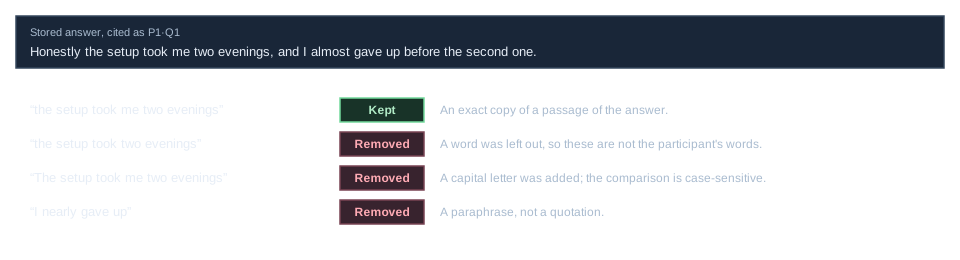
The report brings together counts for closed answers and cited quotes for open ones. Quote checks tie the wording back to a participant’s saved answer, while the question matrix lets you inspect responses across the guide. Checking a quote establishes its source, not whether the simulated participant represents a real customer.
When to use it
Rehearse a discovery guide or concept interview. Look for unclear questions and possible barriers before talking to actual customers.
Example brief
Illustrative input, not a completed run or measured result.
Rehearse an onboarding research guide with simulated administrators. Ask: 'What would you try first?', 'What information is missing?' and 'Which instruction would you ask someone to explain?' Attach the proposed setup screen as stimulus and collect independent answers. Use the rehearsal to refine the guide before recruiting real participants.
What to inspect in the report
Compare answers in the question matrix and trace cited quotes to their source responses. Look for questions that invite ambiguous or repetitive answers, then revise the guide. Quote verification confirms the saved wording, not that a simulated answer represents a real customer.
Explore a concept through moderated discussion in a simulated Focus Group →What you take away
A report with cited answers and a question matrix, combining closed-answer counts with quotes checked against their source responses.
Where it stops
Simulated participants are generated, not recruited. Answers are directional and speak for no real customer.
Explore the other formats
- AI Focus Group SoftwareRun a moderated AI Focus Group with 4–12 generated participants, an editable discussion guide, and findings built from themes and verified quotes.
- Synthetic Audience SimulationSimulate audience reactions with 12–50 generated participants, isolated baselines, networked rounds, descriptive metrics, and an Observer report.
- AI Message Testing with Reach TestCompare up to five message variants with Reach Test. Explore exposure waves, synthetic reactions and audience differences before testing with real people.