
Understand audiences
Simulate audience reactions round by round
Run an idea past a synthetic audience and watch opinion move — or fail to move — round by round.
- Participants
- 12–50 synthetic participants
- You get
- Metrics and Observer report
What makes it different
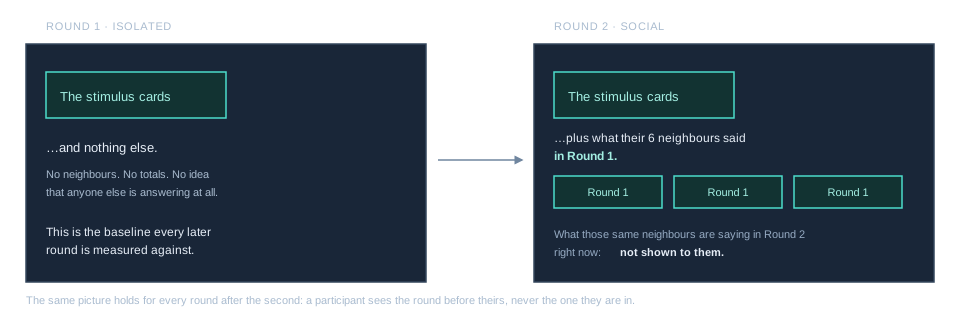
Round one is isolated and becomes the baseline. After that each participant hears a fixed set of neighbours and sees only the round before theirs, never the one they are in.
Where it stops
A synthetic audience is a simulation, not a sample. It measures no real population.
TribeMind
Who hears whom
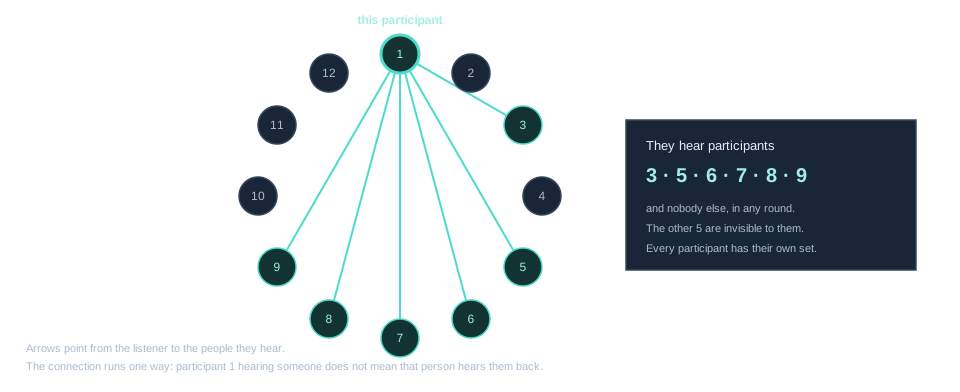
A synthetic audience that all reads the same feed is not an audience, it is one opinion repeated. So in TribeMind nobody hears the crowd. Each participant is given a fixed set of neighbours and hears those, in every round, and nobody else.
The connection runs one way: participant 1 hearing someone does not mean that person hears them back. That asymmetry is what lets an opinion travel through part of the audience instead of arriving everywhere at once.
Rounds are sealed the same way. Round one is isolated — the stimulus and nothing else, not even the knowledge that anyone else is answering — and it is the baseline every later round is measured against. From round two on, a participant sees what their neighbours said in the round before, never what those same neighbours are saying in the round they are in.
Explore the other formats
- AI Focus Group SoftwareRun a moderated AI Focus Group with 4–12 generated participants, an editable discussion guide, and findings built from themes and verified quotes.
- Multi-Agent Team DebateRun two saved AI Teams through private preparation, structured public debate, and a neutral five-dimension scorecard with a reasoned verdict.
- AI Pitch EvaluationEvaluate a pitch with 2–4 independent AI judges who open cold, cross-examine the case, and produce a cited scorecard and verdict.